Learn with us








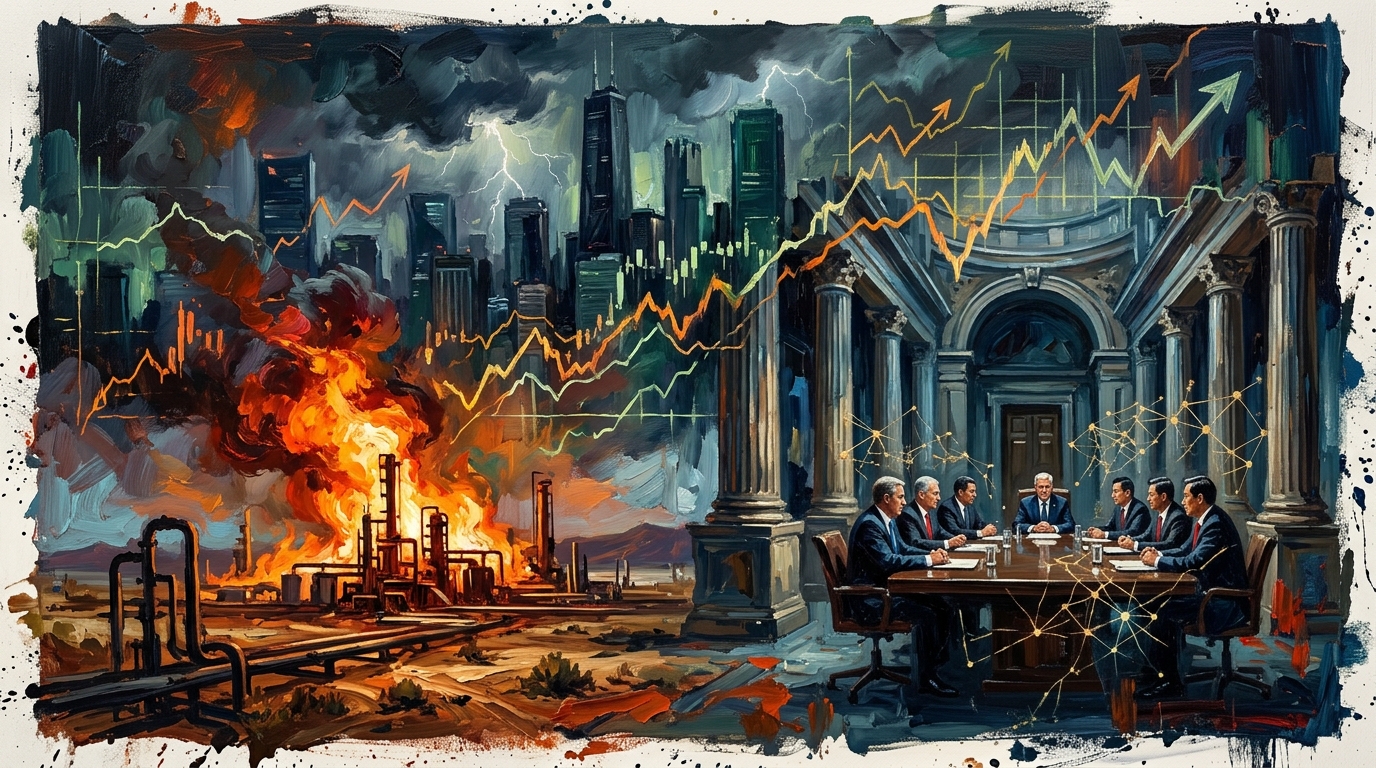
We enter a new week with markets still digesting a heavy dose of information from recent days. Global focus centers on the emergence of a so-called "stagflationary cocktail"—an environment in which policy tightening by the US Federal Reserve (Fed), multi-year high bond yields, and expensive crude oil are creating significantly more restrictive financial conditions for the global economy. In the coming days, forward-looking purchasing managers' index (PMI) readings will be crucial in showing how the real economy is bearing this new, higher cost of capital.
Geopolitical Environment
- Attacks in Saudi Arabia and the oil shock. In the middle of last week, attacks struck the Saudi East–West Pipeline, forcing a suspension of loadings at the port of Yanbu. Given that this facility handles roughly 4 million barrels per day (nearly 4% of global supply), Brent crude prices initially spiked toward $106–$109 per barrel. As extreme concerns over the longevity of these disruptions eased, prices pulled back to around $101–$102 per barrel; however, the commodities market remains exceptionally tight. (Sources: Reuters; New York Times; The Hindu).
- US–China dialogue ahead of crucial summit. Over the past weekend in New York, US Treasury Secretary Scott Bessent and Trade Representative Jamieson Greer held hours of talks with Chinese Vice Premier He Lifeng. The meeting served as preparation for the upcoming summit between Presidents Trump and Xi scheduled for September 24. Alongside trade matters and access to rare earth elements, a key element of the discussions is the launch of an official bilateral dialogue mechanism on "shared risks" associated with the development of artificial intelligence (AI). (Sources: Axios; Bloomberg; Moneycontrol).
Today's Highlights
-
Restrictive mix chokes equity markets. The US central bank (Fed) returned to its tightening cycle, unanimously raising the target range for the federal funds rate by 25 basis points to 3.75–4.00% last week. This marks the first such hike since 2023. In response to these hawkish moves, the 10-year US Treasury yield crossed the 5% threshold, reaching its highest levels since 2007. The combination of high interest rates, 5% yields, and crude oil above $100 is putting strong pressure on stock valuations (especially tech equities) and prompting investors to rotate capital into the energy sector. (Sources: Federal Reserve Board; Reuters; BNN Bloomberg; WSJ live blog).
-
The two faces of China's economy. The latest macroeconomic data from the Middle Kingdom confirm deepening imbalances. On the one hand, industrial production driven by technology and exports grew by a solid 5.2% year-on-year in August. On the other hand, the domestic consumer remains deeply on the defensive—retail sales rose by just 0.4% YoY, and fixed-asset investment dropped 7.2% YoY during the January–August period, which analysts attribute to the ongoing property market crisis. Price indices also point to an absence of demand pressures: the CPI (Consumer Price Index) rose 0.8% YoY, while the PPI (Producer Price Index) rose 3.8% YoY. (Sources: NBS China; Reuters; Bloomberg).
-
Chinese central bank in wait-and-see mode. In light of these data points, the People's Bank of China (PBOC) decided today to leave its benchmark interest rates unchanged for the 16th consecutive month (the 1-year Loan Prime Rate [LPR] was kept at 3.00%, and the 5-year LPR at 3.50%). Independent analyses suggest the PBOC's hands are tied: rate cuts could squeeze already razor-thin net interest margins at Chinese banks (average rates on new corporate loans are already below 3%), and given the hawkish Fed stance, risk accelerating capital outflows and further weakening the yuan. (Sources: Reuters; BigGo Finance; People's Daily).
-
European Central Bank in an energy trap. As a reminder, the ECB raised its three key interest rates by 25 basis points last week (the deposit facility rate now stands at 2.50%). Although preliminary Eurostat data were revised slightly downward (headline HICP inflation—Harmonised Index of Consumer Prices—stood at 3.2% YoY in August), energy price growth alone remained at a dramatic ~14.3% YoY. Available summaries of ECB projections suggest inflation will remain above the 2% target throughout 2026–2027, which effectively leaves no room for rapid rate cuts in Europe. (Sources: The Asian Banker; Eurostat).
-
Vietnam's upgrade becomes a reality. Effective from today's market open (September 21), Vietnam officially joins the ranks of higher-tier emerging markets, having been reclassified by FTSE Russell from a Frontier market to a Secondary Emerging Market. A total of 27 local companies have been added to FTSE global equity indices. The process will be carried out in four tranches running through September 2027, with available estimates projecting that full implementation could bring passive capital inflows of $2.4–$4.4 billion into the Vietnamese market. (Sources: Business Times; Tuoi Tre; Investing.com).
Market Backdrop
- Europe pressured by commodities: Ahead of the Fed meeting, the pan-European STOXX 600 index fell to a 3-month low (around 634 pts). Banks and financial services acted as the main drag, while the energy sector posted solid gains. The index managed a slight rebound as the oil rally paused, illustrating how heavily dependent European equities currently are on commodity markets. (Sources: Reuters; Investing.com).
- Expectations for the Bank of Japan (BoJ): Heading into the weekend, markets buzzed with speculation regarding a Japanese rate hike. Analyses pointed to widespread expectations of a 25 bps move to 1.25% (the highest since the 1990s). At the same time, a very cautious, even "dovish" narrative from Governor Kazuo Ueda was anticipated. This mix of expectations triggered high yen sensitivity, with USD/JPY nervously testing the 152–153 range. (Sources: Reuters; Investing.com; FXStreet).
- Regulators scrutinize AI funds: The US SEC (Securities and Exchange Commission) has issued subpoenas to major Wall Street banks. The investigation concerns the July collapse of the Situational Awareness fund (run by a former OpenAI researcher), which lost roughly 67% of its value due to substantial leverage (around 4x) on AI stocks. The episode is prompting regulators to take a closer look at risk management and leverage provision practices among prime brokers. (Sources: Yahoo Finance; Chatroomweb; independent BIS summaries).
What to Watch
This week will be dominated by purchasing managers' index (PMI) activity readings and rate decisions from smaller yet key European central banks.
- 09/23 (Wednesday, 09:15 to 15:45) – Flash PMIs (France, Germany, Eurozone, UK, US): A series of releases detailing the health of the services and manufacturing sectors for September. For the ECB and Fed, these are the most critical high-frequency gauges showing how economies are navigating higher borrowing costs. Fluctuations in Germany's PMI around the 50-point mark will traditionally impact the euro.
- 09/24 (Thursday, 02:30) – Japan: Flash manufacturing and services PMI, offering insight into economic momentum in the Land of the Rising Sun amid policy tightening by the Bank of Japan.
- 09/24 (Thursday, 09:30–10:00) – Central bank decisions in Switzerland, Sweden, and Norway: The quarterly SNB decision will be closely watched for potential foreign exchange interventions to curb franc appreciation. Meanwhile, the Riksbank and Norges Bank will outline new rate paths, vital for Scandinavian currencies.
- 09/24 (Thursday, 10:30) – Germany: Release of the Ifo Business Climate Index. One of the best leading indicators of sentiment in German business, directly affecting the outlook for the broader Eurozone.
- 09/24 (Thursday, 14:30) – US: Weekly Initial Jobless Claims report. An essential gauge of US labor market resilience following the latest Fed hike.
- 09/25 (Friday, 14:30) – US: Preliminary Durable Goods Orders. A bellwether of business demand for capital equipment, indicating capex appetites in an environment of 5% bond yields.
Aggregation of selected data for this article, editing of the text and the translations were carried out using artificial intelligence.
Déjà vu · market memory
It has happened before
Tap a year on the timeline: what happened then and how the market reacted.Click a year on the timeline: what happened then and how the market reacted.
1980199020002010today
24 July 198739 years ago
A tanker in a US convoy hits a mine in the Gulf.
−2.8%Brent crude that day; the attacks did not push prices up for long
Entry: Tankers in the crosshairs again. 1987 and 2026 – what the Tanker War teaches us
What 1987 teachesHistory doesn’t have to repeat itself: it’s a lesson, not a forecast.
Decode the Markets · terms in this brief
What is the Fed and why does the whole world listen to it?→What does it mean when bond yields rise?→What are interest rates?→What does CPI inflation measure?→
Jacek Pobłocki
Articles: 692Learn with us
Key to the briefsA trader’s encyclopediaDecode the Markets →Terms from our morning briefs, explained briefly and with real market examples.Go deeperAkademia ANALIZ · blogA treasure trove of practical knowledge →When a brief isn’t enough: in-depth market analysis and trading skills, with quizzes.Free callCheck it out!Akademia ANALIZ · one-to-oneIndividual mentoring →From news to your own analysis. Learn to read the market!