Learn with us







The new week on global markets kicked off with a dramatic turnaround in the tech sector, which completely dominated investor sentiment, reversing last week's sell-off. Enthusiasm around artificial intelligence has returned with redoubled strength, serving as a counterbalance to the U.S. Federal Reserve's hawkish stance on interest rates. Meanwhile, in Europe, attention is focused on the deepening divergence in the health of the largest economies and rising energy commodity prices ahead of the upcoming winter.
Geopolitical Environment
- The United States targets Iran's financial network. Washington imposed sanctions on Monday on more than two dozen currency exchange houses, front companies, and individuals tied to an Iranian "shadow banking" network (an unregulated capital flow system), including entities based in the United Arab Emirates, Turkey, and Hong Kong. This network enabled the circumvention of existing restrictions. The U.S. Financial Crimes Enforcement Network (FinCEN) estimated that approximately $14.7 billion moved through this system between January 2025 and August 2026. “This is the last financial lifeline for a bankrupt regime,” – Scott Bessent, quoted in the U.S. Treasury Department release. These measures may harden relations across the Middle East over the long term. (Sources: U.S. Department of the Treasury; U.S. Department of State; FinCEN)
- The COP31 climate summit in Antalya, Turkey, which concluded on Sunday, failed to yield an overarching political agreement, despite extending negotiations by two days. The main bone of contention leading to the breakdown of talks over the final document centered on fossil fuel phasedown provisions. Although several separate thematic decisions were adopted, the lack of broad consensus is a clear sign of headwinds facing the global energy transition. “I am deeply disappointed,” – António Guterres, UN Secretary-General. (Sources: UN News; Associated Press)
Today's Highlights
-
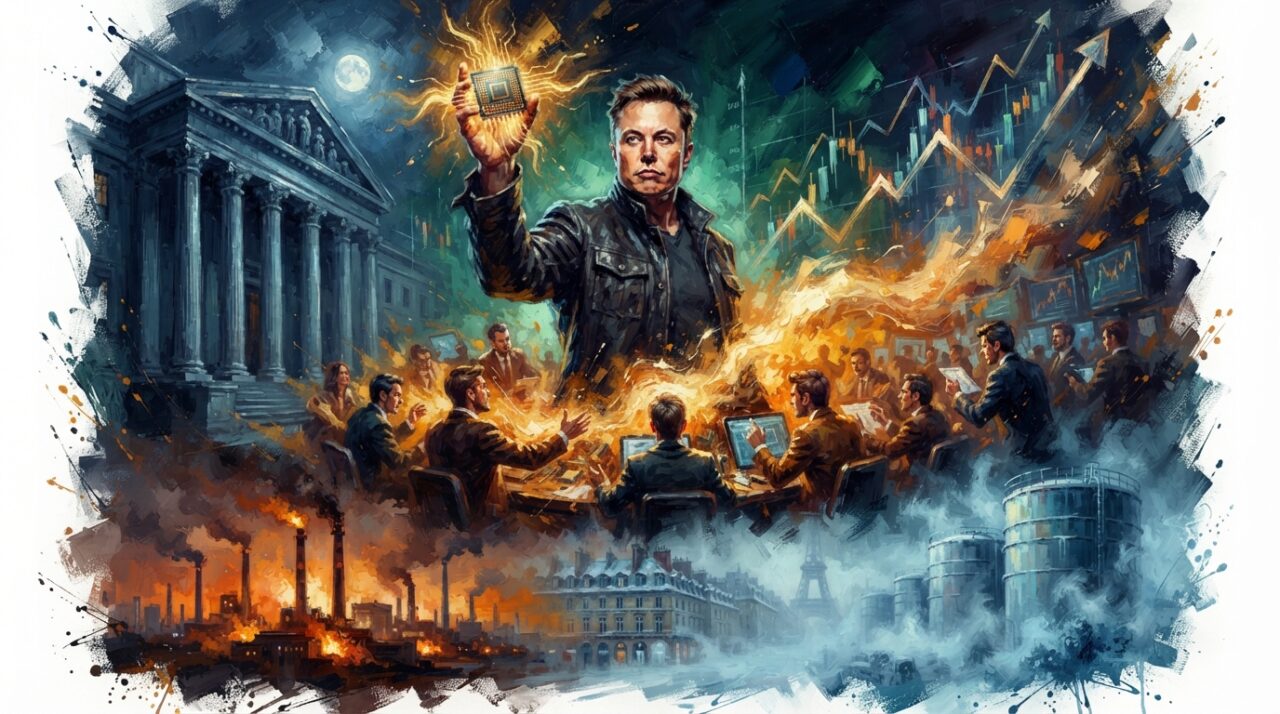
Jensen Huang’s surprise return as President and CEO of Nvidia sparked a massive wave of optimism, rescuing global equity markets. As a reminder, Huang's sudden departure last week triggered panic and a massive correction across the entire technology sector. However, on Monday, the company’s board announced his reinstatement with immediate effect. The market reaction was instantaneous: Nvidia shares soared 31.5%, pulling the broader market along with it. The U.S. S&P 500 gained 4.7%, the Nasdaq Composite jumped roughly 6.5%, and the Dow Jones added around 3%. The euphoria spilled over into Asian markets this morning—Taiwan’s benchmark index surged roughly 9%, South Korea’s KOSPI rose 7.5%, and Japan’s Nikkei gained as much as 5% during the session. The market interprets this as the end of the leadership crisis at the helm of the AI revolution. (Sources: NVIDIA Investor Relations; Reuters)
-
Investors are now certain of a December U.S. interest rate hike in the face of stubborn inflation. Federal Reserve officials leave no doubt about the direction of monetary policy. “Inflation remains too high,” – John Williams, President of the New York Fed. The official projects that inflation will stand at around 3.5% at the end of 2026 and will not return to the 2% target until 2028. As a result, CME FedWatch data shows the market is now fully pricing in (with a 100% probability) a 25-basis-point rate hike at the December meeting. Sustaining restrictive monetary policy supports the U.S. dollar and could pose a challenge for emerging markets. (Sources: Federal Reserve Bank of New York; Reuters; CME FedWatch)
-
The eurozone economy continues its "two-speed" trajectory, putting the European Central Bank in a tough spot. Yesterday’s preliminary Eurozone PMI (Purchasing Managers' Index—a survey gauge of business activity) held steady at 51.7 points (values above 50 indicate expansion). However, this headline masks a structural divergence: while German manufacturing and services are accelerating noticeably, France recorded its sharpest contraction in activity in six months. Furthermore, overall business confidence regarding future economic prospects weakened. Such divergence between the eurozone's two largest economies will complicate the ECB's monetary policy calibration ahead of its December meeting. (Sources: S&P Global; Reuters)
-
The prospect of an impending cold snap and relatively low storage levels are driving up European natural gas prices. On Monday, TTF natural gas futures (the European price benchmark) surged by as much as 8.6% intraday (to around €96.08/MWh) before settling 4% higher at €92.50/MWh. Market jitters stem from forecasts of colder weather across Northwestern Europe combined with EU gas storage sitting at only around 70% capacity. Rising wholesale costs are hitting consumers—in the UK, consultancy Cornwall Insight forecasts that the regulated energy price cap for a typical household will increase by around £443 per year starting in January. (Sources: Bloomberg; S&P Global Commodity Insights; The Guardian; BBC; Cornwall Insight)
Market Background
-
Crude oil declines deepen ahead of the upcoming OPEC+ summit. On Monday, oil prices retreated toward roughly three-month lows—European Brent slid 3.46% to $89.37 per barrel, while U.S. WTI shed 3.88% to settle at $80.17. Prices are pressured by increased Middle Eastern supply and the resumption of flows from Libya’s Sharara pipeline. Investors are positioning ahead of the crucial OPEC+ alliance meeting scheduled for November 29. (Sources: Reuters)
-
The European Central Bank warns of hidden debt risks in the artificial intelligence sector. In its latest Financial Stability Review, the ECB estimated that off-balance-sheet commitments of the largest tech firms exceeded $4 trillion in Q2 2026. The central bank highlights that complex and opaque financial linkages across the AI supply chain obscure real underlying demand, and a potential correction in the sector could send shockwaves through broader credit markets and the non-bank financial sector. (Sources: European Central Bank; SUERF)
-
French pharmaceutical giant Sanofi acquires Insmed in a deal valued at $41 billion. Sanofi will pay $175 per share in cash, representing a 17.5% premium over the last closing price. Subject to regulatory approvals and closing conditions, the transaction is expected to finalize in the first half of 2027. (Sources: Sanofi; Reuters)
What to Watch
Today and in the coming days, markets will closely watch incoming macroeconomic data, which could cement or alter expectations surrounding central banks.
11/24 (Tuesday)
- 10:00 – Ifo Business Climate Index (Germany): A leading barometer of economic activity in Europe's largest economy. We will see whether yesterday's positive PMI figures are mirrored in the sentiment of German businesses.
- 16:00 – Conference Board Consumer Confidence Index (U.S.): Will reveal how American consumers perceive the current labor market, which translates directly into their propensity to spend.
11/25 (Wednesday)
- 14:30 – Core PCE Inflation (U.S.): The Federal Reserve's preferred inflation gauge. A higher reading will likely cement the decision for a December rate hike.
- 14:30 – Initial Jobless Claims (U.S.): Brought forward due to Thursday's Thanksgiving holiday. The latest litmus test of the U.S. labor market's resilience.
- 20:00 – Fed Beige Book (U.S.): A report on economic conditions across the 12 Federal Reserve districts, providing a broad view of business activity and wage pressures.
11/26 (Thursday)
- 13:30 – ECB Meeting Accounts (Eurozone): The meeting minutes will reveal the balance of views within the Governing Council against the backdrop of divergent European economic growth.
11/27 (Friday)
- 00:30 – Tokyo CPI Inflation (Japan): A key leading indicator for national Japanese inflation that could fuel speculation about further rate hikes by the Bank of Japan (BoJ).
- 08:45 and 09:00 – Flash CPI Inflation for France and Spain: A batch of data that will shape expectations ahead of the aggregate eurozone print.
11/29 (Sunday)
- OPEC+ Meeting: Crucial discussions regarding oil production quotas for 2027 in light of declining crude prices.
Aggregation of selected data for this article, editing of the text and the translations were carried out using artificial intelligence.
Déjà vu · market memory
It has happened before
Tap a year on the timeline: what happened then and how the market reacted.Click a year on the timeline: what happened then and how the market reacted.
1980199020002010today
24 July 198739 years ago
A tanker in a US convoy hits a mine in the Gulf.
−2.8%Brent crude that day; the attacks did not push prices up for long
Entry: Tankers in the crosshairs again. 1987 and 2026 – what the Tanker War teaches us
What 1987 teachesHistory doesn’t have to repeat itself: it’s a lesson, not a forecast.
Decode the Markets · terms in this brief
What is the Fed and why does the whole world listen to it?→What are interest rates?→What does CPI inflation measure?→
Jacek Pobłocki
Articles: 692Learn with us
Key to the briefsA trader’s encyclopediaDecode the Markets →Terms from our morning briefs, explained briefly and with real market examples.Go deeperAkademia ANALIZ · blogA treasure trove of practical knowledge →When a brief isn’t enough: in-depth market analysis and trading skills, with quizzes.Free callCheck it out!Akademia ANALIZ · one-to-oneIndividual mentoring →From news to your own analysis. Learn to read the market!